
What Henry County Deed Records Actually Convey
Every recorded deed names the parties, states the interest conveyed, and fixes the date the instrument entered the public record. The land description rides along too. Henry County deed records also hold mortgages, releases, liens, easements, plats, and corrections, so document type always matters. Read the instrument, not the label or tax card.
| Deed Type | What It Does | Common Use |
|---|---|---|
| Warranty deed | Conveys the stated interest with title covenants written into the instrument. | Conventional arm's-length conveyance. |
| Quitclaim deed | Conveys whatever interest the grantor has without promising that the interest is complete. | Family transfers, name corrections, or interest cleanup. |
| Personal representative or trustee deed | Transfers property through an estate, trust, or representative capacity. | Probate and trust administration. |
| Corrective deed | Corrects a party name, description, or other error in an earlier instrument. | Repairing the recorded chain while preserving both references. |
| Tax deed | Documents a completed transfer following the statutory tax-sale process. | Post-redemption tax-sale transfer. |
A mortgage burdens land without moving ownership. The same goes for judgment liens and other encumbrances. A tax-sale certificate is only a lien interest, subject to redemption, and not automatically a tax deed. So read the indexed image and any later releases or deeds before treating a filing as a transfer. Other papers reshape a chain without replacing the conveyance. A release ends a mortgage. An assignment shifts who may enforce an interest, and an easement may touch only part of the tract. A plat or replat can even supply the description later deeds rely on. Corrections need double care. Both the original and the corrective instrument can matter. Build a chronology instead: record each instrument's date, parties, type, reference, and affected land rather than hoarding anything with deed in the title.
The Henry County Recorder Is the Deed Custodian
Henry County Recorder keeps the deed records for the county. The office sits at 101 S Main Street, Room 106, New Castle, IN 47362, and answers the phone at 765-529-4304. Doors open Tuesday through Thursday from 7:00 a.m. to 5:00 p.m. and Friday from 7:00 a.m. to 4:00 p.m., while Monday stays closed. For searching any time of day, the office page points to Doxpop, where documents can be found by person, parcel, or document.
Whether you write or visit, give staff what they need to pull the right record. Include full party names and their roles, a parcel or alternate ID, the instrument type, and an approximate recording date, plus either lot, block, and subdivision or section, township, and range. Say if you want a plain or certified copy. Those details keep a deed from being confused with a mortgage, release, plat, or correction filed alongside it.
Note: Confirm hours, staff, and contact details on the official Recorder page before any visit.
Searching Henry County Deeds in Doxpop
The county-linked Doxpop recorded-document service handles basic searches along with paid accounts and advanced tools. The public interface needs just a name and a region. Advanced options add legal-description and document criteria when names collide.
| Search field | How it narrows deed records | Practical caution |
|---|---|---|
| Party name | Finds grantors, grantees, and parties indexed on recorded instruments. | Try name variants and former names. |
| Search region | Limits the search to Henry County or another selected area. | Confirm Henry County is selected. |
| Lot, block, subdivision | Targets platted land through recorded plat terminology. | Use spelling found on the deed or tax-card clue. |
| Township, section, range, quarter | Targets unplatted descriptions. | A street address may not appear on an older deed. |
| Document information | Restricts by the available type and recording criteria. | Do not assume every relevant interest is labeled as a deed. |
The Doxpop landing page shows the recorded-document entry point itself. Open the Henry County Recorder search source to run the same party-name workflow directly.
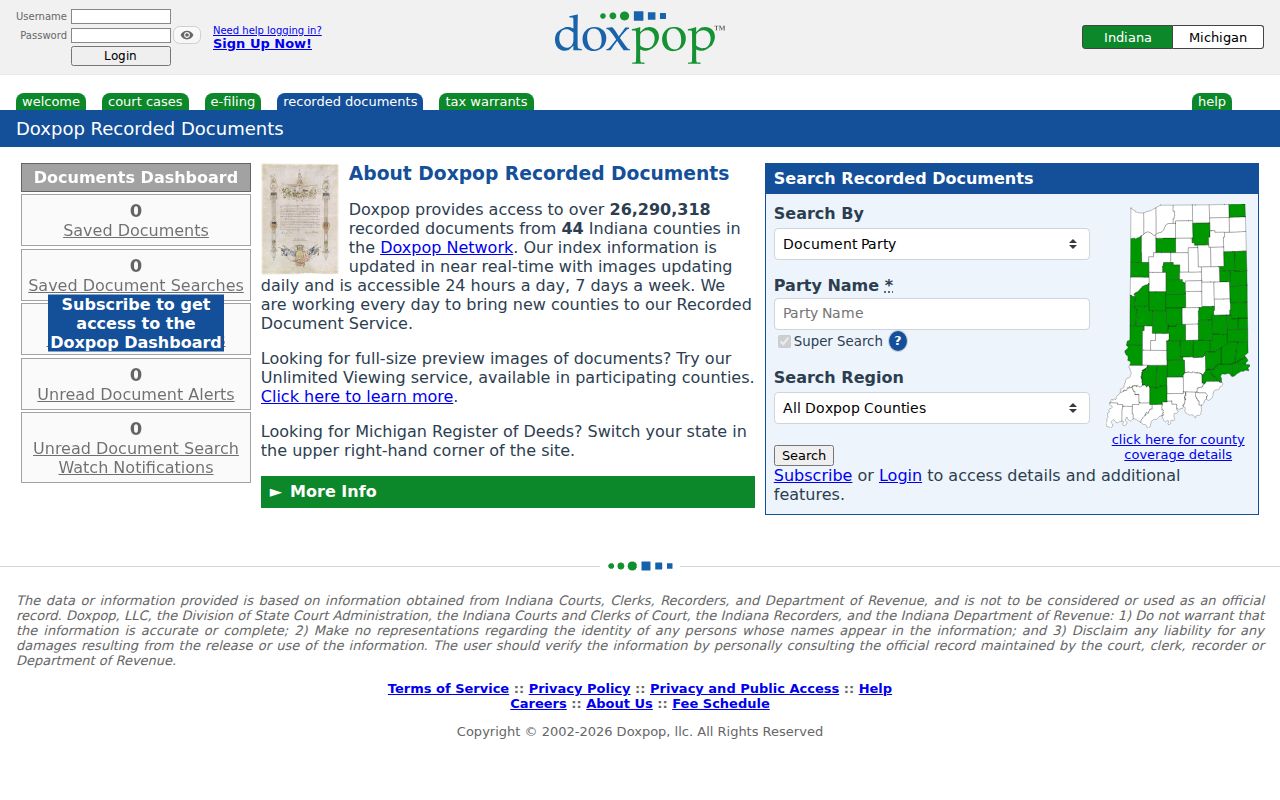
The live search follows the party-name and region workflow. For a specific document image or the county's coverage cutoff, ask the Recorder or check the live system. When names multiply, move to the land. Platted property rewards exact terms. Try subdivision, addition, lot, block, outlot, and plat reference. Unplatted land takes township, range, section, quarter, tract, and acreage terms instead. Estates, trusts, businesses, and name changes after marriage call for searching both an earlier and a later name. Log every failed spelling too. That log shows staff which variants and regions were covered before they dig into an older or separate index.
Walking Henry County's Grantor-Grantee Trail
Every chain starts with the newest deed you know. Follow the conveying party backward, saving each recording reference as you go. Addresses and parcel numbers are discovery keys. A match in legal description, parties, and recording reference is what makes each backward link solid.
- Locate the current owner's acquisition deed by searching that owner as grantee.
- Read the full instrument and record the grantor, legal description, recording date, and instrument or book/page reference.
- Search that grantor as an earlier grantee, then verify the same tract rather than accepting a name match alone.
- Repeat the process, preserving corrective deeds, partial conveyances, plats, and exceptions that alter the path.
- When the digital index ends or no image appears, take the last reliable reference to the Recorder and older deed books.
- Grantor
- The party conveying the stated interest.
- Grantee
- The party receiving that interest.
- Chain of title
- The ordered sequence of instruments affecting ownership of the same land.
- Book/page and instrument number
- Recording references used to retrieve the filed document; preserve whichever label appears.
Note: Save both the parcel ID and the alternate ID, but let the prior grantor and the full legal description carry you from deed to deed.
Why a Henry Tax Description Is Only a Search Clue
The archived Henry Beacon card offers a brief tax description. It also says plainly that the abbreviation is not for legal documents. A card still helps. It can recover a subdivision name, lot number, acreage clue, parcel ID, or alternate ID. It can also surface an earlier transfer reference. It cannot replace the deed's granting language. Nor can it stand in for the full legal description. Watch for partial tracts, outlots, metes-and-bounds exceptions, road and utility strips, replats, and vacations. The list may include annexations and corrections too. The street address can stay put regardless. Doxpop's recording glossary helps translate platted and unplatted terms into workable search inputs.
Common myth. A matching tax card, map polygon, or index hit is not proof of present title. Use it to find and read the recorded instrument.
Older Henry County Deed Books and Place Names
Henry County dates to 1822. That was decades before parcel numbers and modern street addresses existed. Deed research that far back depends on era-appropriate place language. The Indiana State Library Henry County guide points to original-record offices, microfilm, maps, newspapers, and index leads. Its companion Henry microfilm finding aid lists historic court, probate, partition, and related series that can explain how land changed hands. A deed-specific film call number should be confirmed with the library.
Old land descriptions rarely match current parcels on their own. Historic road names, post offices, township references, subdivisions, and annexations usually supply the bridge. The Henry County Historical Society research library holds family files, yearbooks, Bibles, scrapbooks, directories, and local histories. Those materials can tie a name to a place. Treat them as leads only. Legal conclusions still come from the deed book, plat, or court record.
Property Watch Uses Names and Descriptions
Free alerts are available through Doxpop Property Watch, a service the Recorder links to. It sends a notice when an indexed document matches a name or legal-description term you have registered. That makes it easier to spot a new recording. Rural alerts, though, do not reliably work from a street address or parcel number, because Indiana recorder indexing is built around parties and legal descriptions rather than location labels.
Choose your alert terms with care. Register sensible name variants and, where they exist, stable subdivision or land-description terms. An alert is only a prompt. It is not proof that a recording is valid, invalid, or tied to the parcel you care about, so check every match against the official instrument and the intended tract.
Note: Property Watch is an alerting aid, not title insurance or continuous certification of the deed record.
Getting a Copy of a Henry County Deed
Start with the online index and any available preview or image. Contact the Recorder when the image is missing, a marginal notation is unclear, or certification is required. Requests can go in person, by phone, or in writing if detailed enough. Give the instrument number or book and page when known. Otherwise supply names and roles, an approximate date, the document type, parcel identifiers, and legal-description search terms.
Doxpop may offer subscription or paid-image options. Paying does not certify an image. No single current copy fee can be quoted here. Ask the Recorder whether the item is available as inspection, an electronic copy, a plain paper copy, or a certified copy. Request the authorized fee basis before paying anything. Under the Indiana Access to Public Records Act guidance, inspection, search, and review are generally free. Authorized copying or format fees may apply.
Recorded, not guaranteed. The Henry County deed index shows what was indexed, not a title opinion. Unrecorded interests, indexing errors, and later filings can matter, so obtain the official document and professional title help when legal certainty is required.