
Inside Henry County Tax Records
Henry County tax records work as a linked set rather than one sheet. Beacon and the Auditor describe the parcel and its assessment. The Treasurer tracks bills, payments, delinquency, and tax-sale leads. DLGF supplies the state rules behind the assessment. A deed may show who acquired the land. But it says nothing about whether the current installment was paid.
| Tax field | What it answers | Official source |
|---|---|---|
| Land and improvements | How the total assessment is divided | Beacon / Auditor |
| Deductions and credits | Which adjustments affect the tax calculation | Auditor |
| Tax district and rates | Which local rate components apply | Auditor rate page |
| Charges and payment | What was billed and the account status | Treasurer |
| Appeal record | How a disputed assessment moves through review | Assessor / PTABOA / DLGF |
Indiana assesses at market-value-in-use with a 100 percent ratio. That ratio is not a sale forecast. Trending, physical review, deductions, credits, levies, and caps can each move what Henry County property tax records show.
Henry County Treasurer Search Fields
The Henry County Treasurer parcel search accepts several identifiers. Begin with one strong key, since the portal itself warns that too much information can narrow away a valid match.
| Search key | Best use | Result clue |
|---|---|---|
| District | Limit a known tax district | District code |
| Parcel number | Open one known account | Parcel and state ID |
| Owner name | Find related or recently changed parcels | Owner and mailing line |
| Tax year | Keep one billing period in view | Selected year |
| Property address | Begin with a known site | Address, city, state, ZIP |
The Treasurer page posts an update date. It also labels its output “Not for Official Use!” Treat it as a locator. Confirm any material balance with the Treasurer or Auditor. The portal is a starting point, not the final word on an account.
Note: When saving a Henry County tax result, keep the portal’s tax year, update date, parcel number, and state ID together.
Trace a Henry County Tax Bill
Match the parcel key to its assessment detail. Skip shortcuts. A similar owner name or an old parcel number can masquerade as the current bill on a Henry County tax search.
- Search the Treasurer by street address or parcel number. Remove extra city or ZIP terms if no match appears.
- Save the district, parcel number, state ID, owner line, tax year, and property address from the result.
- Open the linked Henry County Property Tax gateway and compare Auditor or Beacon assessment details.
- Read charges, payment, delinquency, and tax-sale status as separate facts. Ask the office to verify any figure used in a transaction or appeal.
- Assessed value
- The value assigned under Indiana assessment rules.
- Levy
- A tax rate component approved for a taxing unit.
- Deduction
- An authorized reduction that can affect taxable value.
- Tax lien
- A statutory claim tied to unpaid property taxes.
Henry County Split-Parcel Tax Clue
A parcel split or combination can leave bills under more than one identifier. The Treasurer offers a practical local tip: if the parcel changed during the last two years, search by the owner’s last name to find every bill. That catches all open accounts. Record each parent, child, and state ID first. Only then decide an account is missing.
Next, compare legal-description terms and transfer history in Beacon against Recorder instruments such as a replat, survey, correction, boundary agreement, or deed. The tax system documents billing. It does not decide whether the split was legally complete.
Henry County Tax-Year Labels
Indiana assessment records carry two dates. The assessment year measures value; the payable year marks the following year’s bill. Henry Auditor detail pairs those labels with assessment figures, deductions, gross tax, credits, and tax columns. Quote both labels when comparing years.
The distinction matters most during change. Indiana’s statewide cyclical reassessment begins July 1, 2026 for 2026 Payable 2027 and the next four years, inspecting roughly one quarter of parcels each year. A card can change without any sale. No new deed is required either.
The DLGF assessed-value search offers a state route to assessment years, land and improvement totals, details, and downloads.
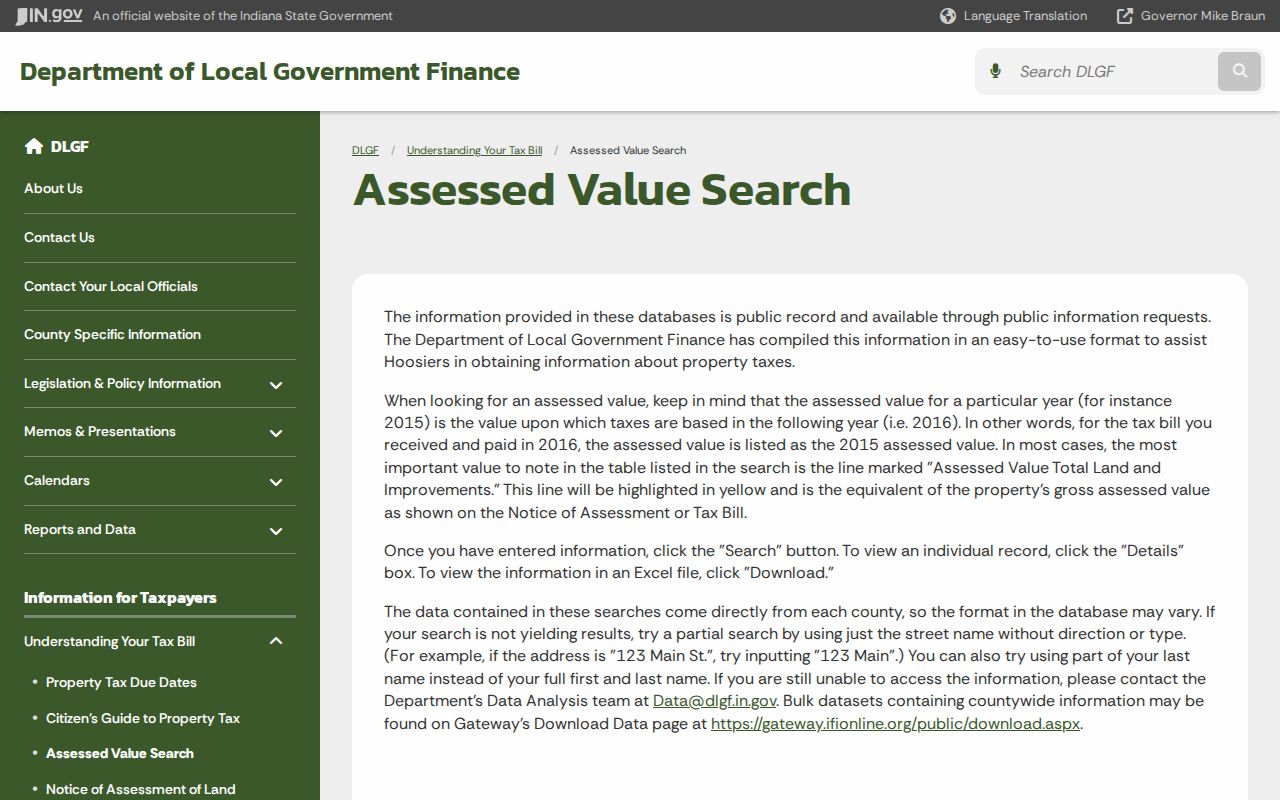
The state interface makes a useful comparison point. Henry County’s own records still remain the operational source for local account detail.
Henry County Tax Districts
The Auditor rate table separates county, township, city, school, library, and special components. A mailing address alone proves little. The municipality in an address does not settle which tax district applies. Use the parcel’s displayed district and year.
One example: district 006 Middletown posted a total rate of 2.760300 for 2025 Payable 2026. That number is dated, not countywide. Recheck the parcel and year first.
Note: A tax district helps explain a bill, but it does not establish a municipal boundary, zoning status, or recorded ownership.
Henry County Tax Deductions
Deductions and exemptions live on the assessment side of Henry County property tax records. Indiana DLGF publishes the forms. They cover homestead, over-65, disability, veteran, rehabilitation, renewable-energy, abatement, exemption, and ownership-change matters. A filed form proves nothing by itself. It does not show qualification or Auditor approval.
Compare the deduction line across both years. After a transfer, keep the ownership-change filing and ask the Auditor which deduction stays active. A missing deduction can change the tax even when the gross assessment holds steady. For anything material, get the parcel's current deduction detail from the Auditor. Do not infer status from a bill total.
Henry County Tax Office Roles
Two Henry County offices split the property tax work, and neither duplicates the other. The Auditor handles assessment, deductions, gross tax, credits, rates, exemptions, and tax-sale administration. The Treasurer handles bills, charges, payment and delinquency status, judgments, and lender files. Label the source office beside every figure in any full review. That habit keeps a Henry County property tax record honest.
Auditor detail pairs each assessment year with its payable year. The rate page breaks out county, township, city, school, library, and special components. Those fields show how a bill was assembled. They do not prove recorded title. If an owner name clashes with a recent deed, date the tax record. Take the ownership question to the Recorder.
Treat the Treasurer search as a locator only. The page itself carries a "Not for Official Use!" label. Any payment or delinquency claim tied to a sale, redemption, or appeal deserves confirmation from the office. Save the parcel, state ID, tax year, query, and retrieval date alongside the result.
When online access fails, call or write the Auditor or Treasurer with a narrow list. Include parcel and alternate IDs, the property address, owner name, assessment year, and payable year. Also include the exact bill, deduction, rate, or tax-sale field needed. An APRA request under IC 5-14-3 should describe the record with reasonable particularity. Inspection, search, and review are generally free under IC 5-14-3-8(b). A copy or authorized format fee may still apply.
Did the response come back partial? Ask whether the office searched a prior parcel ID, archived billing year, separate rate table, deduction file, or tax-sale series. A portal outage or missing web row never makes an unofficial data source authoritative. The county office itself remains the route to a verified record.
Keep payment evidence in its original form. A portal total, receipt, canceled payment, billing history, and office certification each answer a different question. When an amount is disputed, request the charge and payment detail for the named parcel and tax year.
Henry County Tax-Sale Records
The Treasurer and Auditor offer the first check for delinquency. Henry County's official tax-sale notice, along with its county-linked SRI route, adds parcel IDs, judgments, minimum-bid components, registration details, and redemption warnings. Read the notice as an event in collection. It is not proof that ownership changed.
A tax-sale certificate creates a lien interest subject to redemption. It is not automatically a deed. Follow the parcel through current Treasurer and Auditor status. Then search the Recorder for a certificate, redemption, deed, or release. MyCase may show related litigation.
Title caution. A bill, delinquency entry, or tax-sale list cannot prove the present owner of Henry County land.
Contest a Henry County Assessment
An Indiana assessment appeal begins with Form 130, filed with the local assessor. The DLGF appeal instructions draw a line between subjective value disputes and objective errors. Objective errors include wrong measurements, characteristics, or classification. Strong evidence helps either way. Bring the property record card, comparable sales, and photographs. Add measurements, an appraisal, zoning facts, and correction documents.
From there, the review path can move from the assessor to the county Property Tax Assessment Board of Appeals. It can then go on to the Indiana Board of Tax Review and the Indiana Tax Court. Keep the assessment notice, filing, evidence, orders, and every stated deadline. An APRA request under IC 5-14-3 can help obtain records. It will not extend an appeal deadline, though. The state appeal page lays out the Form 130 route in full.
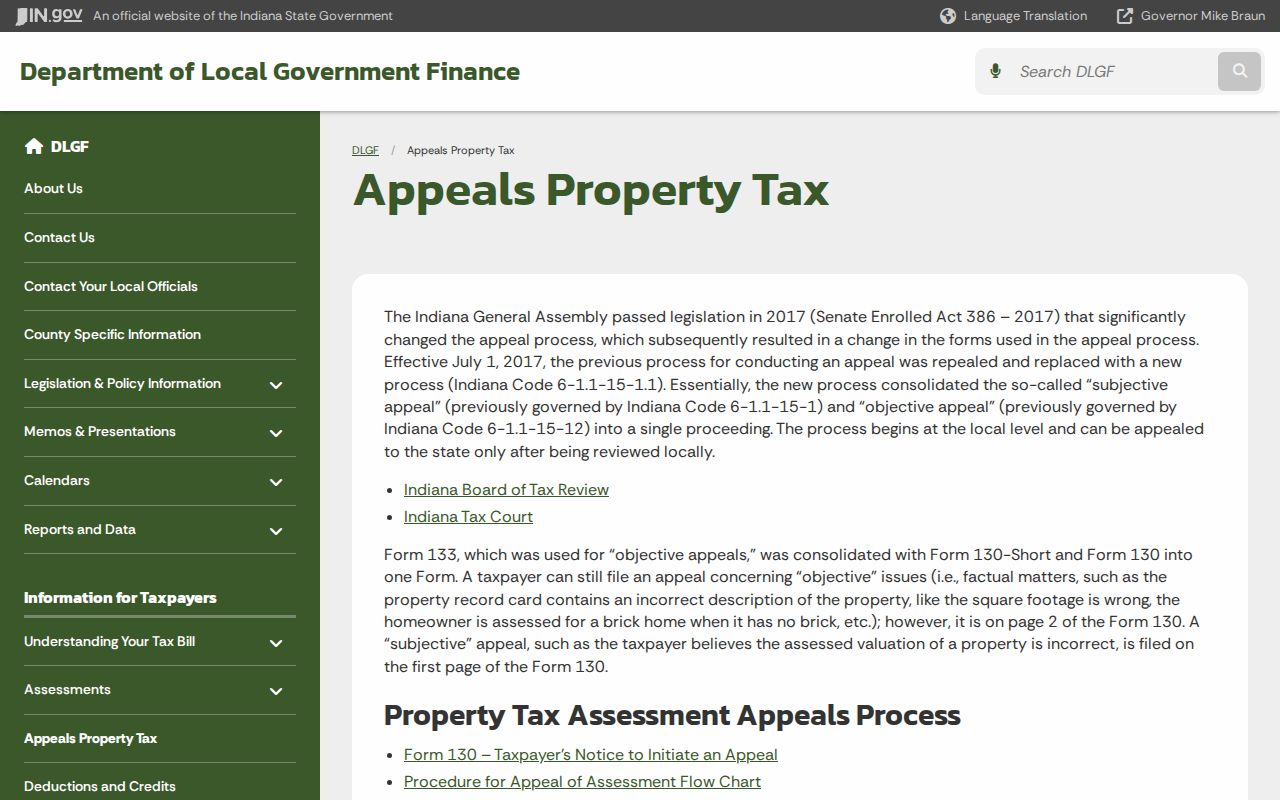
Use the official instructions tied to your notice year, since assessment procedure and effective dates can change.
Deadline matters. File through the local assessor within the period stated on the assessment notice; a records request does not pause that clock.