
Trace Henry County Former Owners
Every former-owner search in Henry County begins with the newest solid deed and steps backward from there. The Recorder holds the official property records: deeds, mortgages, releases, easements, liens, and plats, plus the indexes that tie those papers together. The Doxpop Indiana Recorder search offers an around-the-clock route by person, parcel, or document. Treat its results as leads. The official record lives with the Recorder. Confirm every find there before relying on it.
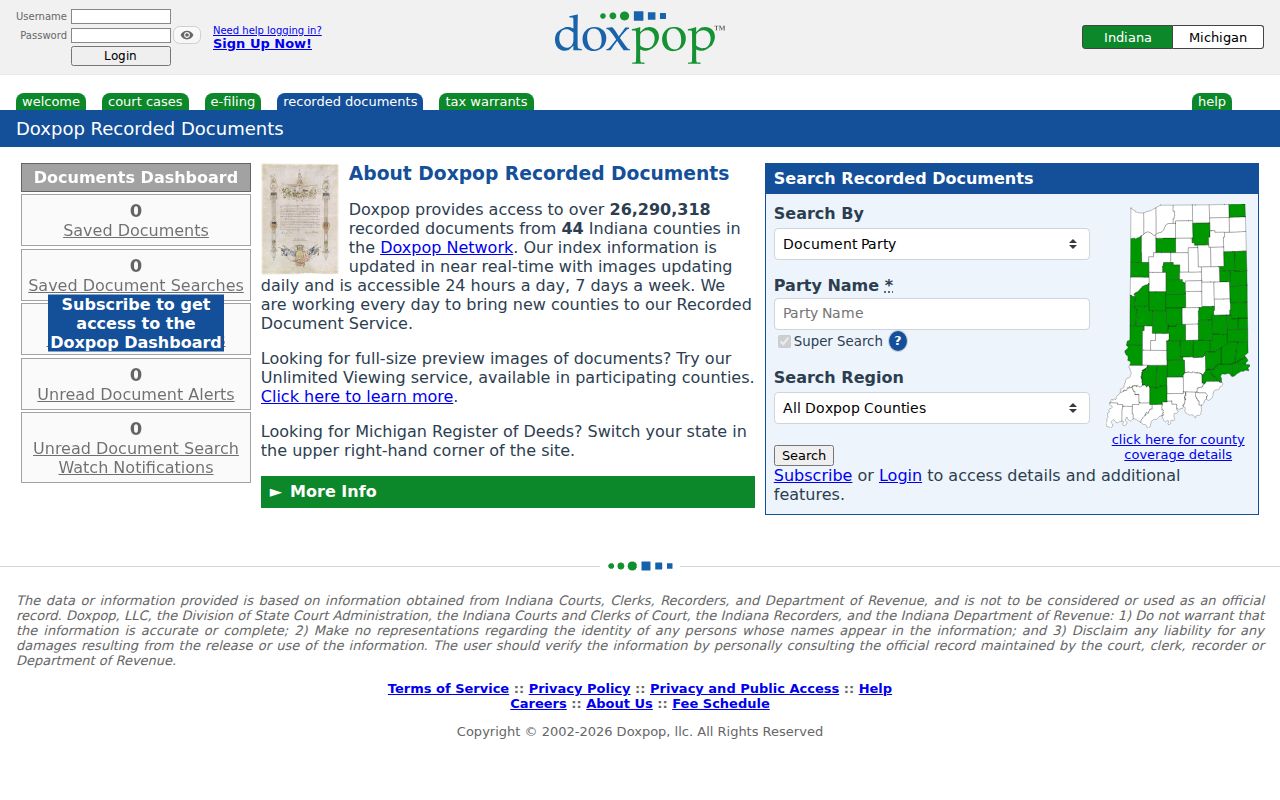
That index points to each transfer. Verify the matching book, page, instrument number, and legal description with the Henry County Recorder before accepting any link in the chain.
| Ownership source | Time reach | Custodian or access | Best use |
|---|---|---|---|
| Doxpop deed index and images | Henry cutoff not stated in the inspected source | Online; Henry County Recorder confirms range | Locate transfers by party and legal terms |
| Recorded deed books and indexes | County formation forward, subject to office holdings | Recorder office, 101 S Main Street, Room 106 | Reconstruct the authoritative chain |
| State Library microfilm | Historic county series listed in its Henry guide | Indiana State Library finding aids | Bridge older books and indexes |
| Plats, maps, and local collections | Varies by series | Recorder, State Library, Historical Society | Decode former place names and lot descriptions |
No firm start year is posted for Henry County's online deed index. Ask the Recorder which years and document types the search actually covers. Do this before concluding a trail has gone cold. A blank result is not the end. Office hours listed by the county are Tuesday through Thursday, 7:00 a.m. to 5:00 p.m. Friday hours are 7:00 a.m. to 4:00 p.m. Monday is closed.
Walk the Henry Deed Chain Backward
The chain runs in reverse. Pull the current parcel card for search keys only. Then anchor the work on the newest recorded deed, copying its instrument number, recording date, parties, prior-instrument reference, and complete legal description.
- Find the current parcel in Henry County Beacon; save the parcel ID and alternate ID.
- Search Doxpop for the current owner as grantee and identify the newest deed matching the land.
- Read the grantor's name, then search that person or entity as a grantee.
- Repeat while matching each legal description, prior reference, and recording date.
- When the web trail stops, request the reverse index, deed book, or microfilm for the earlier period.
- Grantor
- The person or entity transferring an interest.
- Grantee
- The person or entity receiving that interest.
- Chain of title
- The ordered series of instruments that transferred the same land.
- Reverse index
- An index organized by the receiving party, useful for finding how a seller first acquired the parcel.
Log every possible transfer in its own row. Record the execution date, recording date, grantor, grantee, deed type, consideration if stated, and the book and page or instrument number. Keep both dates; signing and recording often differ. A prior-instrument reference is gold. It can point straight to the next older deed. Still compare the land described, because a grantor may have conveyed only part of a tract, reserved an easement, or carved out acreage that later became a separate parcel. The land description is the thread that holds the whole chain together.
Former Owner Names Shift
Names rarely sit still in Henry County deed records. A former owner may surface under a married name, initials, a trust, a business suffix, or a plain misspelling. Doxpop indexing varies in punctuation and party role. So search the surname alone, add and drop a middle initial, and test a former married name. Preserve an entity's full legal style, and match the parcel number and legal description at each step. A name alone is never enough.
Partial tracts call for a different habit. Follow the land description rather than the street number. Platted land speaks in lots, blocks, additions, and subdivisions, while unplatted tracts lean on township, range, section, quarter calls, acreage, and metes and bounds. A tax card's brief description is a locator only. The county states plainly that it is not meant for legal documents.
Representative roles change the search path. When a trust appears, test both the trustee's name and the trust's indexed style. For a corporation or limited liability company, keep punctuation and suffixes but also try a shortened name. Executors, personal representatives, sheriffs, and tax-sale purchasers all point toward a related estate, court, or tax process, and the first notice may not be the transfer itself. The recorded conveyance is the real link.
Probate Can Bridge Previous Owners
Probate can break a tidy chain of Henry County owners. Search Indiana MyCase by the deceased owner, the personal representative, and likely heirs whenever a deed mentions an estate, survivorship, or a court order. MyCase shows party names, court, case type, status, filing dates, and some linked public documents. The Henry County Clerk holds older or unlinked material.
Probate papers explain who could convey. The recorded personal-representative deed or other transfer instrument is still the link that carries title. Death certificates carry direct-interest restrictions, and birth certificates stay closed for 75 years. Use only the minimum facts needed.
Historic Henry Address Clues
Henry County dates to 1822. Modern parcel numbers rest on older conventions built around deed books, plats, township lines, and rural routes. An early deed will not name today's street address. Annexation or replatting can even pull an old rural description inside a later town's limits.
The Henry County Historical Society offers family files, directories, yearbooks, Bibles, scrapbooks, maps, and local histories that tie an old name to an old place. These are leads, not deeds. Keep the historic wording exactly as written. It becomes the key for searching Recorder indexes and State Library holdings back to the county's earliest years.
Insider method. Save both parcel identifiers and use each deed's prior grantor as the next backward search key.
Plats Reframe Henry Prior Owners
Henry County parcel histories rarely move in straight lines. A tract may be split, combined, replatted, or partly conveyed. Track every parent and child parcel ID. Cards, deeds, plats, and tax records all carry identifiers worth keeping. Search the Recorder for a replat, survey, boundary agreement, vacation, annexation, or correction tied to the description, since a later parcel polygon cannot show who owned the exact earlier tract without that work.
Local history can sharpen an older description. New Castle's annexation and commercial district records supply place terms, and Knightstown's National Road and railroad past does the same. Treat these as context only. The deed and the recorded plat establish the transfer and the land description.
Check each deed description against a short list. It should carry parcel and alternate IDs, lot and block or section and township, acreage and plat reference, the street address as a clue, and calls to roads, streams, railroads, or adjoining owners. A correction may repair a name or a description. Either way, the original transfer date stays relevant. A replat may renumber lots, and a road or utility strip can separate land that looks continuous on the current tax map.
Access Henry Ownership History
Three routes cover most Henry County ownership questions. Beacon works well online for parcel identifiers, and Doxpop indexes recorded instruments. The Recorder's office helps in person with a grantor or grantee index, deed book, image, or plat. Callers and emailers should give the parcel ID, alternate ID, both party names, document type, and approximate recording date. Include legal-description terms. Also say whether an office or certified copy is needed.
Older chains of title reach back through the Indiana State Library's Henry County guide. Its microfilm holdings serve the same purpose. Local historical collections can then resolve names and addresses that early deeds leave unclear. Under the Indiana Access to Public Records Act, IC 5-14-3, a request must identify records with reasonable particularity. Inspection, search, and review are generally free under IC 5-14-3-8(b), though authorized copy charges may apply.
A good archival request names the current parcel or address. It should also give the suspected predecessor tract, all known parties, and the approximate years. Ask the repository to point to a deed or grantor-grantee index, plat book, probate, partition, or court series. Request the reel, book, volume, page, or item citation as well. Say whether an index entry is enough or an image is needed. A bounded request like this works far better than asking for every record about a property. It also makes any gap in the chain easier to describe plainly.
Limits of Henry Former-Owner Records
Every source answers a different question. An assessor card names a former tax owner. It does not prove when or on what terms title passed. A Doxpop hit may be an easement, lien, or mortgage rather than a deed, and a directory may list an occupant instead of the owner of record. Note each source's date and role. Describe gaps as unresolved rather than filling them with assumptions.
An index chain is not a title examination. For a legal conclusion, pull the recorded instruments and seek qualified title advice; the separate Henry County deed records resource covers copy and certification details.
Lawful use. Research former owners for property history, estate work, or purchase diligence; never use records to target or harass a person.