
Compare Henry County Property Values
One parcel can carry several numbers at once. Henry County assessment records split the land value from the improvement value. Each answers a different question. A recorded deed may state the consideration paid in a transfer. A private appraisal, by contrast, estimates worth for a set date and purpose. Mixing them up is the fastest way to misread a property record.
| Value type | Meaning | Where to find it |
|---|---|---|
| Assessed value | The value used within Indiana's property-tax system | Henry County Beacon and assessment records |
| Market value-in-use | Indiana's standard tied to a property's current use | Assessor records and DLGF guidance |
| Last sale or consideration | The amount associated with a recorded transfer, subject to the deed's terms | Recorded deed and transfer records |
| Appraised value | An opinion for a stated date and assignment | A qualified private appraisal, not the tax card |
Keep the date and source beside every number you compare. An old sale price may predate later improvements. A current assessment can change without any deed being recorded. And a transfer between relatives may never reflect an open-market price at all.
Find Henry Assessed Value
Start with the Henry County Beacon assessment page. Its interface sits behind a Cloudflare gate at times, so verify the labels you see. Typical Beacon fields for Henry parcels include owner name, address, parcel ID, and tax ID. Results may also show Alternate ID, Ownership, City, Area, ASV, Ref Num, and STR values. The Indiana DLGF assessed-value search offers a second official route. It confirms the year and the level of detail.
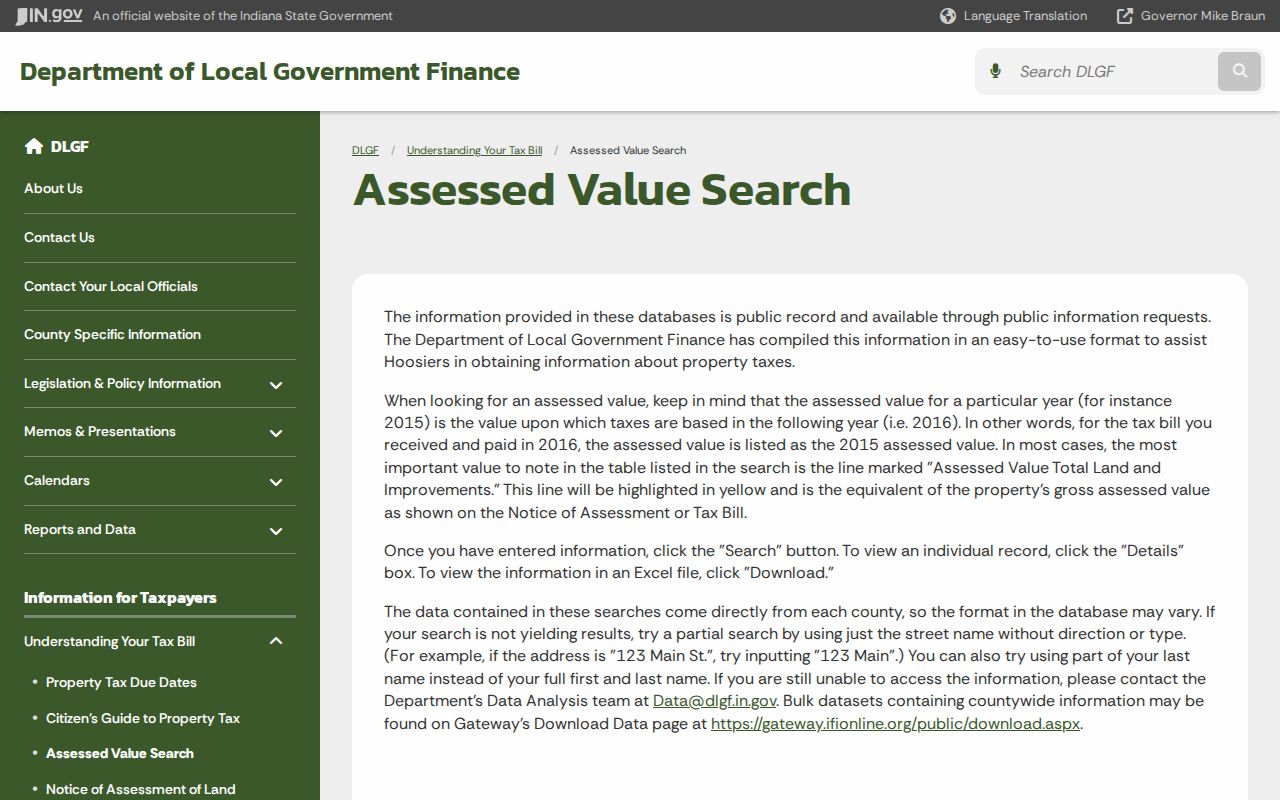
The state screen makes the same point from another angle. Save the assessment year and open the detail view before weighing one Henry County value against another.
- Search the full address, then try the street with fewer filters if no match appears.
- Confirm the parcel ID and alternate or state ID.
- Open the parcel card and record the assessment year.
- Copy land, improvement, and total assessed fields separately.
- Save the card date and verify later changes with the Assessor.
Splits and combinations need extra care. For a parcel divided or merged within the last two years, the Treasurer suggests searching by the owner's last name to surface every tax bill. Record both the old and new parcel numbers so a changed ID does not look like a missing property record.
Henry County Valuation Terms
Precise terms prevent a misleading comparison.
- Assessed value
- The tax-system value assigned to land and improvements.
- Market value-in-use
- Indiana's value standard based on the property's current use.
- Assessment ratio
- A measure used to compare assessments with market evidence across property groups.
- Consideration
- The value stated or reflected in a conveyance; it is not always an ordinary sale price.
- Reassessment
- A scheduled review that can change parcel data and assessed amounts.
Read Henry Land and Improvements
An archived Henry Beacon industrial card shows how the fields fit together. It identifies a parcel and alternate ID, acreage, class, neighborhood, site conditions, utilities, paving, and separate land and improvement assessments. Its tax description comes with a warning that it is not for legal documents. Land and improvement figures explain what builds the assessment. They do not prove buildable area, code compliance, an exact construction date, or surveyed acreage. When a structure seems absent or a field looks wrong, save the card and ask the Assessor which inspection year and source produced the entry. The archived 1112 S 25th Street card works well as a field model. It shows parcel ID 030-82415-00, alternate ID 33-12-14-430-202.000-016, 9.34 acres, an industrial class, and distinct land and improvement sections. Those dated samples teach where values sit on a Henry card, though they should never be copied into a current valuation without a fresh retrieval.
Annual Henry Property Value Changes
Indiana assessments can move through annual adjustment with no deed recorded at all. DLGF frames market value-in-use and ratio studies as core parts of the state's assessment system. So a year-to-year change needs its assessment year, not just the newest total. Statewide cyclical reassessment begins July 1, 2026 for 2026 Payable 2027. It runs over the next four years. During that span, 25 percent of parcels are physically inspected annually. That process can update card details and values without any change in ownership. When comparing figures, keep the inspection cycle, assessment date, and payable year together.
Key distinction. Assessed value supports taxation; it is not a sale forecast or a private appraisal.
Match Henry Sale Price to Records
A recorded deed may hold consideration and a transfer date. An assessment card may carry a transfer-history section too. Neither tells the whole story alone. Look at the deed type. Warranty, quitclaim, estate transfer, trust transfer, correction, and partial conveyance each mean something different. Confirm the legal description covers the same land as the parcel being valued. Recording date and execution date can also differ. A current parcel may be a child of a larger parent tract. Match instrument number, parties, legal description, and old parcel IDs. Do that before treating a past figure as comparable-sale evidence.
Read Henry Assessment Ratios Carefully
Indiana DLGF ratio studies weigh assessed values against sale evidence across groups of property. A median near the state's 100 percent target describes the group, not any single parcel. The coefficient of dispersion shows how tightly assessments cluster around that median. Neither statistic is a parcel-specific appraisal. A Henry County owner can use ratio data as context. It helps when testing whether similar parcels are treated uniformly. Property-level proof still comes first. That proof includes the current record card, the correct assessment year, verified physical characteristics, comparable sales, photographs, measurements, and any zoning or use facts affecting market value-in-use. Never apply a countywide percentage to one parcel and call the result its market price. Note: Ratio statistics describe a broad assessment pattern. They do not set the correct Henry County property value for one address.
Separate Henry Value and Deductions
A deduction never changes what the assessor measured. Neither does a credit, exemption, or tax cap. These adjustments act on taxable value or the final bill. They leave the underlying assessed value in place. That is why Henry County property records work keeps the gross land and improvement total apart from every later tax adjustment.
The Indiana DLGF publishes statewide forms for many programs. Homestead, over-65, blind or disabled, disabled veteran, rehabilitation, renewable energy, vacant building, heritage barn, and abatement are all on the list. Eligibility cannot be guessed from an owner's age, a mailing address, the look of the property, or an old card. The Henry County Auditor is where filings happen and get confirmed. Deadlines must be checked for the exact year in question.
Historical cards deserve extra care. Indiana forms state that mortgage and contract deductions ended. This change applies to bills beginning with 2023 payable 2024. A deduction on an older card may simply no longer be claimable.
Question a Henry County Value
Start by sorting the problem. Is it factual, like wrong square footage or a misfiled property class? Or does it dispute the value itself? Gather the property card, the notice, photos, measurements, and any sales evidence. Note the date on each item.
The Indiana DLGF appeal route opens with Form 130 at the local assessor. From there a case can climb to the county Property Tax Assessment Board of Appeals. Next comes the Indiana Board of Tax Review. Finally a case can reach Indiana Tax Court. Watch the deadline printed on the notice for that year. Filing a public-record request will not extend it.
A data correction and a value appeal are different tasks. Ask the Assessor which one fits the disputed field. Keep the appeal aimed at the assessment. The Treasurer and Auditor records handle bill calculations, payment status, and tax-sale risk.
Middletown Shows the Year Trap
The Henry County Auditor's rate table offers a useful example. It lists Middletown district 006. The sample total rate is 2.760300 for 2025 Payable 2026. That exact label matters. It does not cover every Middletown mailing address, another district, or another tax year.
The example also proves a tax rate is not a property value. County, township, town, school, library, and special components all exist. Each acts on the calculation after valuation is done. For bill details, deductions, credits, caps, and appeal steps, the Henry County property tax records resource is the right stop. It is not the assessed-value inquiry.
What Henry Property Value Omits
Assessment records leave plenty unsaid. They reveal no survey, no hidden defects, no permit compliance, and no environmental conditions. Easement scope and what a buyer will pay also stay off the card. A GIS polygon can orient the parcel but cannot set a legal boundary. The tax-card owner of record may even lag the latest deed.
Match the question to the office. The Recorder holds the transfer instrument. City or county offices keep permits and zoning decisions. The Assessor handles field corrections. For a formal current estimate, get a qualified appraisal. Tie every conclusion to its record and date.
Any "as of" value question needs its date defined first. Use the assessment year for tax value. Use the recording or execution date for a transfer. For an appraisal, use its effective date. If the portal displays no date, mark that gap. Then request the underlying record from the Assessor.